In critical industries such as oil and gas, aerospace, power plants, and civil engineering, early fault detection and equipment health monitoring are critical for safety and productivity. Acoustic emission testing (AE) has emerged as one of the most important advanced non-destructive testing (NDT) techniques in recent decades . This technique utilizes mechanical waves generated within a material to proactively detect and identify faults in real time.
What is an acoustic emission test?
Acoustic emission is a phenomenon that occurs when a defect (e.g., a crack, abrasion, or localized fracture) forms or expands. The elastic energy stored in the material is released and propagates in the form of elastic waves. Piezoelectric sensors detect these waves and process them using electronic systems.
Unlike many NDT methods that are static in nature (such as X-ray or ultrasound imaging, which are used to investigate existing conditions), the EIA method is dynamic and time-based ; that is, it reveals active defects and ongoing processes.
How does the EA test work?
In short, the approach is based on:
-
Generation of sound waves : Any structural change or rapid movement of material (such as crack opening or local sliding) releases energy.
-
Wave propagation: Elastic waves propagate in a solid medium and reach the surface.
-
Sensor detection : Sensors installed on the surface of the part receive these waves and convert them into electrical signals.
-
Data processing : AE analysis software processes the data and determines the location, intensity and number of emission sources.
Important parameters when testing EA
Various indicators are used to analyze and interpret noise level data. The most important of these are:
-
Amplitude : Indicates the strength of the received signal.
-
Count : The number of times the signal exceeds a given threshold.
-
Power : The total energy of the signal.
-
Effect : the occurrence of a particular signal at a particular time and place.
-
Position : The time difference between the waves arriving at the sensor is used to determine the location of the signal source.
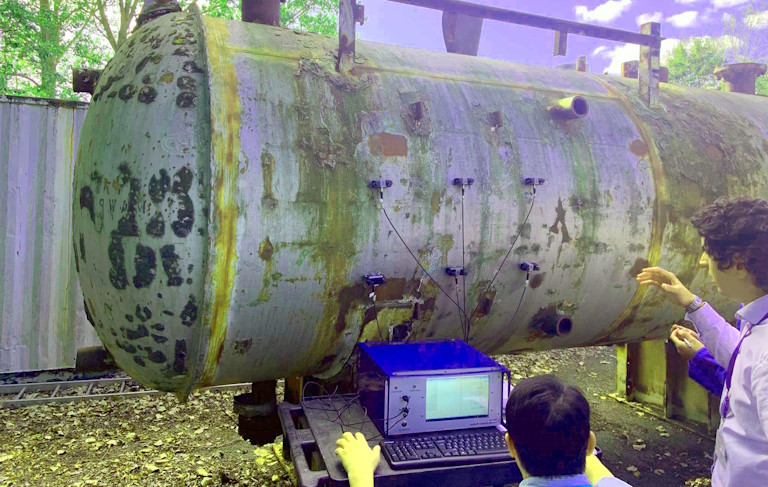
Equipment and components of the AE system
A complete sound distribution system typically includes the following components:
-
Electrical vibration sensors (usually piezoelectric sensors) convert vibrations into electrical signals.
-
The preamplifier amplifies weak signals.
-
Devices for recording and processing signals, including digital maps and analysis software.
-
GPS determines the fault location based on the time the signal was received.
-
Computer hardware and software for storing and analyzing data in the form of charts and reports.
Application of acoustic emission for testing purposes
This method is used in many industries because it can detect active defects and enable real-time monitoring:
-
Pressure vessels and pipelines
-
Monitoring the condition of oil, gas and chemical storage tanks.
-
Detecting growing cracks and power outages
-
-
power plant
-
Monitoring of turbines, boilers and generators
-
Identification of critical points in pressure equipment
-
-
aviation and automotive industries
-
Monitoring the condition of composite and metal structures
-
Detection of fatigue and damage caused by dynamic loading
-
-
Civil structures and bridges
-
Monitoring large structures and assessing stability
-
Identify active cracks in concrete and steel.
-
-
nuclear industry
-
Continuous monitoring of critical equipment in nuclear power plants to prevent sudden failures
-
Advantages of the AE test
-
Real-time monitoring
-
Limited number of sensors, large coverage
-
Detect active errors instead of passive ones.
-
In many applications, a long break is not necessary.
-
Ability to accurately determine the source of an error
Limitations and challenges of EA testing
Although the AE method offers many advantages, it also has limitations:
-
High sensitivity to ambient noise (mechanical vibrations, sound, etc.)
-
Subject-specific data interpretation required
-
Inactive defects (defects that do not grow and do not generate signals) cannot be detected.
-
More expensive than some common NDT methods.
-
Calibration equipment and trained operating personnel are required.
AE testing standards and guidelines
To ensure the correct conduct of this test, various standards and recommendations have been developed. The most important of these are:
-
ASTM E1316: Standard Vocabulary for Non-Destructive Testing (including Acoustic Emission)
-
ASTM E750 : Standard Test Method for Calibration of Air Emission Devices
-
ASTM E1419 : Acoustic Emission Testing of Pressure Vessels
-
EN 13554 : European standard for the monitoring of structures using AE techniques
-
ASME Code, Section V, Article 12 : AE Guide to the ASME Code
The process of implementing the AE project in industry
A typical acoustic emission test process includes the following steps:
-
Define the inspection objectives (e.g. monitoring of pressure vessels).
-
Design the sensor position according to the part geometry.
-
Installation and calibration of the devices
-
Testing under real load or operating conditions
-
Data acquisition and processing in software
-
Analysis of results and preparation of technical reports
Future and perspectives of sound propagation
Advances in digital technologies, artificial intelligence, and machine learning are improving the accuracy of acoustic emission data analysis. The use of acoustic emission systems for structural integrity monitoring is increasing significantly and is expected to become a common safety monitoring tool in critical industries in the future.
Finally
Acoustic emission testing (AE) is an advanced and effective non-destructive testing technique that can detect defects early and locate the source of damage in real time. Although this method requires sophisticated equipment and specialized analysis, it is widely used in critical industries such as oil and gas, aerospace, energy, and civil engineering due to its potential to prevent unexpected failures and improve safety .