Visual inspection is one of the simplest, most widely used, and most effective quality control methods in numerous industries, ensuring the quality of parts and structures. This method, often abbreviated as VI , underlies many non-destructive testing (NDT) techniques and is often preferred. This article provides an overview of the principles, equipment, advantages, limitations, and applications of visual inspection.
Definition of visual inspection (IV)
Visual inspection is a process in which an inspector examines the surface of a part or structure with the naked eye or with the help of devices such as magnifying lenses, mirrors, special cameras and binoculars to detect visible defects such as cracks, corrosion, holes, distortions, surface irregularities or assembly problems.
Due to its simplicity and low cost, this method is often the first step in the quality control process and in many cases can provide valuable information to the inspection team without the need for other advanced methods.
Date and location of visual inspections
Since ancient times, people have used visual methods to inspect the quality of tools and structures. Thanks to scientific and industrial advances, visual inspection has become an official standard method described in inspection manuals and international standards such as ASME , API , AWS , and ISO . Today, this method is a cornerstone of non-destructive testing and a mandatory requirement for many industrial projects.
Principles and phases of visual inspection
For the proper implementation of virtual modeling, certain standard principles and steps must be followed. The most important of these are:
-
Surface Preparation :
Before inspection, the surface of the part must be cleaned of any contaminants such as oil, grease, paint or dust to ensure accurate inspection. -
Choose appropriate tools : Depending on the situation, use aids such as a magnifying glass, caliper, ruler, inspection mirror, flashlight or camera system .
-
Environmental control :
Adequate lighting, a suitable viewing angle, and the ability to see different parts of the product are crucial. If adequate general lighting is not available, artificial lighting of normal intensity can be used. -
Inspection Procedure :
Inspectors carefully examine the surface for defects such as cracks, porosity, weld breaks, corrosion, or discoloration. -
Recording and archiving of results :
The results of the inspection are recorded in a report in written or graphic form for later decision-making.
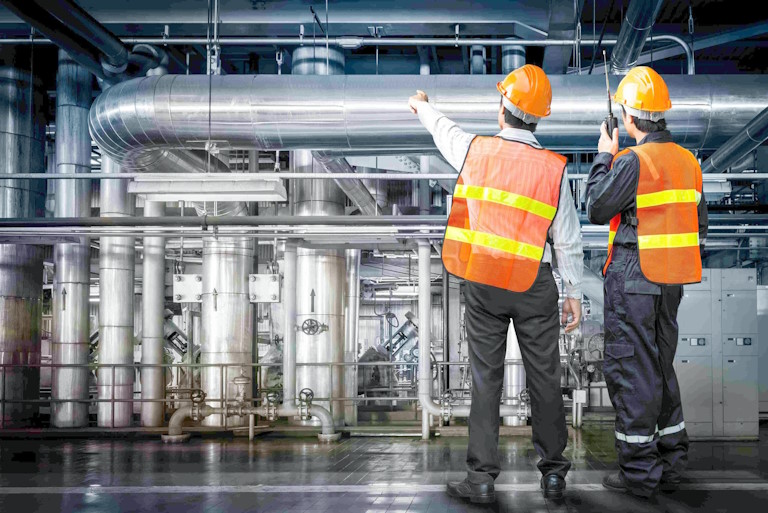
Visual inspection of the equipment used
To improve accuracy and accessibility, various tools are used in addition to the human eye. The most important of these are:
-
Magnifying lenses and handheld microscopes for examining small surface details.
-
Mirror for examining hard-to-reach areas
-
LED lights and special bulbs provide ample lighting .
-
Industrial cameras and digital cameras are used to take pictures and videos of the desired area .
-
Endoscopes and borescopes for examining the interior of pipes and confined spaces
-
Measuring instruments for measuring dimensions and checking compliance with standards , such as calipers, welding gauges and rulers.
Types of visual inspections
Visual inspections can be divided into two main categories:
-
Direct visual inspection:
In this method, the inspector examines the object directly and without intervention. This method is typically used when the surface of the object is visible. -
Remote visual inspection:
This method uses instruments such as cameras , mirrors, and binoculars to inspect surfaces that are not directly accessible. It is commonly used in the aerospace, oil, and petrochemical industries.

Advantages of visual inspection (IV)
Visual inspection is widely used in various industries due to its unique properties. Its advantages include:
-
Lower costs compared to other non-destructive testing methods
-
Simple and quick implementation
-
You don’t need complicated and expensive equipment.
-
Ability to quickly detect surface defects
-
It can be used at any stage of production or operation.
Limitations and disadvantages of visual inspection
Although television offers many advantages, there are also limitations that should be considered:
-
Only surface defects can be detected, internal defects are not visible.
-
The quality of the results depends largely on the qualifications and experience of the examiner .
-
Poor lighting or restricted access increases the risk of human error.
-
Some very small cracks or breaks cannot be detected without help.
Application of visual inspection in various industries
Visual inspection is used in almost all industries, both heavy and light. The main applications include:
-
Welding and metalworking industry : welding quality control, crack detection, edge preparation and porosity
-
Oil, gas and petrochemical industry: monitoring of pressure vessels , pipelines, valves and sensitive equipment
-
Aerospace and automotive industries : Inspection of critical components to ensure safety
-
Power plants : control of turbines, boilers and pressure booster systems
-
Construction industry : Inspection of metal frames, concrete structures and threaded connections.
Standards and requirements for visual inspection
Conducting the VT test according to international standards guarantees the quality and consistency of the results. Key regulatory documents and standards include:
-
ASME Section V (for non-destructive testing)
-
AWS D1.1 (for welded steel structures)
-
ISO 17637 (International Standard for the visual inspection of welds)
-
API 650 and API 653 (for storage tanks and their periodic inspections)
Skills and qualifications of a VT inspector
In addition to good eyesight and the ability to operate optical instruments, opticians must have in-depth knowledge of standards, metallurgical principles, manufacturing processes, and welding techniques. The qualifications of the examiners are usually confirmed by internationally recognized training and examinations (e.g., ASNT or PCN).
Finally
Although visual inspection (VI) is considered the simplest non-destructive testing method, its importance for ensuring product quality and improving structural safety is undeniable. It is cost-effective, quick to perform, and allows the detection of many surface defects before they become serious. Despite some limitations, such as the inability to detect internal defects, VI holds an important place in many industries as the first and most important inspection step.