Large storage tanks used in the oil, gas, petrochemical, chemical, and even food industries play a crucial role in the production and storage of materials. These tanks are typically installed above ground and are used to store large volumes of liquids. The safety and cleanliness of these tanks are critical, as any leak or malfunction can lead to significant economic losses, safety risks for employees, and even serious environmental damage.
Developed by the American Petroleum Institute (API), API Standard 653 is specifically designed for the inspection, repair, modification, and reconstruction of above-ground metal tanks. It complements API Standard 650 in tank construction and addresses issues that arise after commissioning.
API 653 Scope
API 653 applies to the following tanks:
-
They are made of low-carbon steel or alloys.
-
It is located above the Earth’s surface and operates under atmospheric pressure.
-
They are manufactured according to API 650 or API 12C standards.
The standard provides recommendations for the assessment, inspection, repair, maintenance and restoration of various tank components, including the floor, walls (shell), roof, nozzles, welded joints and even the foundation.
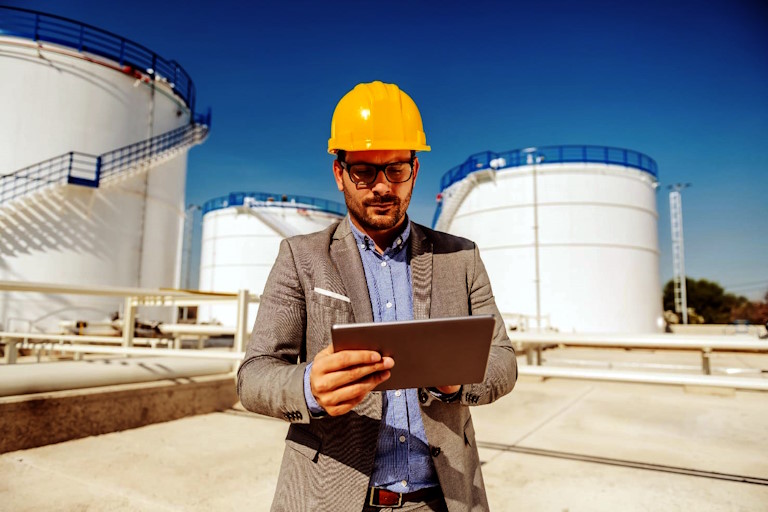
According to the testing principles of API 653
Tank inspections can generally be divided into two categories:
-
External inspection:
With this method, the tank remains operational while the inspector performs a visual inspection of the exterior, roof, connections, and foundation. This inspection helps detect surface leaks, visible corrosion, abnormal deformation, and the condition of the paint or coating. -
Internal inspection:
This inspection is performed during tank operation. The tank is emptied and the interior surface is cleaned. This allows the inspector to accurately assess the condition of the bottom, welds, corrosion-prone areas, and cracks. The inspection also measures the remaining thickness, corrosion rate, and condition of the interior coating.
Interval testing
According to API 653, the inspection program should be developed taking into account the operating conditions, the type of material stored, and the maintenance history. In general:
-
Typical checks are carried out daily or monthly by on-site staff.
-
Every 5 years a full external audit must be carried out by a certified auditor in accordance with API 653.
-
A complete interior inspection is typically performed every 10 years or more frequently (depending on wear and tear or condition).
The specified time periods may vary depending on actual corrosion data and risk assessment.
Information verified
When testing according to API 653, the following components must be carefully checked:
-
Tank bottom : This is one of the most important parts of the tank , as it has direct contact with the ground or foundation and is most susceptible to corrosion. It’s important to measure the thickness of the bottom and inspect it for holes and cracks.
-
Tank body : Check the tank walls for internal and external corrosion, deformation, weld cracks, bottom subsidence, etc.
-
Roof : Depending on the roof type (fixed or floating), check the condition of the beams , columns , welds, and sheathing. Roof corrosion can lead to leaks or structural damage.
-
Nozzles and fittings : Fluid entry and exit points, edges and welds are very sensitive due to stress concentrations and direct contact with the fluid.
-
Foundation and subsoil : Cracks in the foundation, landslides or changes in slope can deform or even damage the tank.
Maintenance according to API 653
API 653 not only defines inspection criteria but also provides maintenance recommendations. The most important of these are:
-
Welding and repair of structures : All welding must be carried out using approved methods and electrodes and must be subject to non-destructive quality control, for example by ultrasound or X-ray.
-
Replacing or strengthening sheets: If the thickness of a wall or ceiling has fallen below the permissible limit, new sheets can be welded on or reinforcing patches can be applied.
-
Overhaul : If a tank has been severely damaged or has undergone significant modifications, a complete overhaul may be carried out in accordance with the recommendations of API 653.
-
Modifications : Any changes to the original design, such as adding a new nozzle, must be made in accordance with the technical requirements and after careful testing.
Benefits of implementing API 653
Implementing this standard offers numerous benefits to all industries, including:
-
Increased safety : Reduces the likelihood of leaks, explosions or tank ruptures.
-
Environmental protection : Do not allow chemicals or oils to enter the soil or water.
-
Cost reduction : By identifying problems early, you avoid major repairs and production downtime.
-
Longer fuel tank life: Proper inspection and maintenance can significantly extend the life of your fuel tank.
-
Regulatory Compliance : Many countries require regular inspections according to API Standard 653.
Challenges and key points when implementing API 653
-
Hidden Corrosion : The presence of coatings or sealants can conceal actual corrosion, necessitating advanced non-destructive testing.
-
Older tanks : Structures built to older standards may require additional analysis and maintenance.
-
Repair quality : The use of unsuitable welds or materials may introduce additional risks.
-
Data management : Recording and maintaining records of inspections and repairs is critical for analyzing wear trends and future planning.
Finally
API 653 is one of the petroleum and petrochemical industry’s most important tools for the safe and efficient management of aboveground storage tanks. This standard provides detailed recommendations for periodic inspections, repairs, upgrades, and rehabilitation.
Strict adherence to this standard not only improves safety and environmental performance , but also helps extend the tank’s service life and reduce overall costs. Ultimately, stable and reliable tank operation can be ensured through a combination of regular inspections, certified inspectors, and technical maintenance.