Axial fans are essential components in many industrial processes that require efficient mixing. Thanks to their ability to generate a flow parallel to the axis, these fans are widely used in various industries. This article provides a comprehensive overview of the design, applications, and advantages of axial fans.
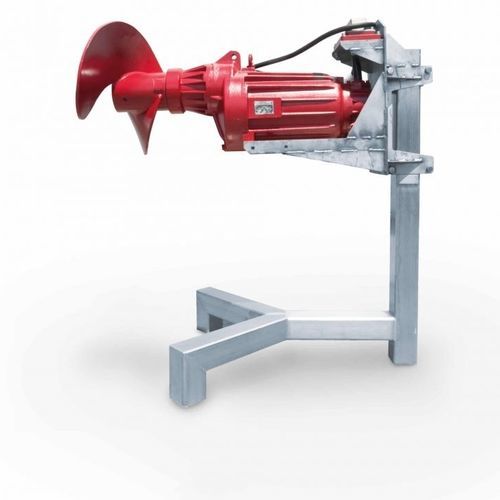
Design principle and operating principle of an axial fan
Main functional mechanism
Axial fans rotate and force the fluid to flow parallel to the axis. This unique characteristic makes them ideal for applications requiring high flow rates.
Important design criteria
-
Blade angle : typically 15 to 45 degrees.
-
Number of blades : Usually 2 to 6 blades.
-
Ratio of diameter to height : direct influence on the flow pattern.
-
Coverage level : The percentage of the surface covered by the blades.
Main types of axial fans
1. Blower
-
The simplest and most commonly used type
-
It typically contains 3 to 4 blades.
-
Suitable for low viscosity liquids.
2. Axial turbine
-
The design is more complex because curved blades are used.
-
Higher efficiency at medium viscosity
-
More efficient energy consumption
3. Blade-like deterrent
-
Modular and customizable design
-
A special feature is its high flexibility in various application areas.
-
Applicability in liquids containing suspended particles.
Industrial applications
chemical and petrochemical industry
-
Mixing reactor
-
Heat transfer
Food and pharmaceutical industries
-
mixed raw materials
-
Fermentation process
-
Stop
Water and wastewater treatment
-
Pool aeration
-
Mixed chemical products
-
Prevention of siltation
Key advantages
-
High energy efficiency : Enables a higher volume flow with lower energy consumption.
-
Low cutting force : suitable for delicate materials.
-
Flexibility : Suitable for a wide viscosity range .
-
Easy to maintain : Simple design without complex components.
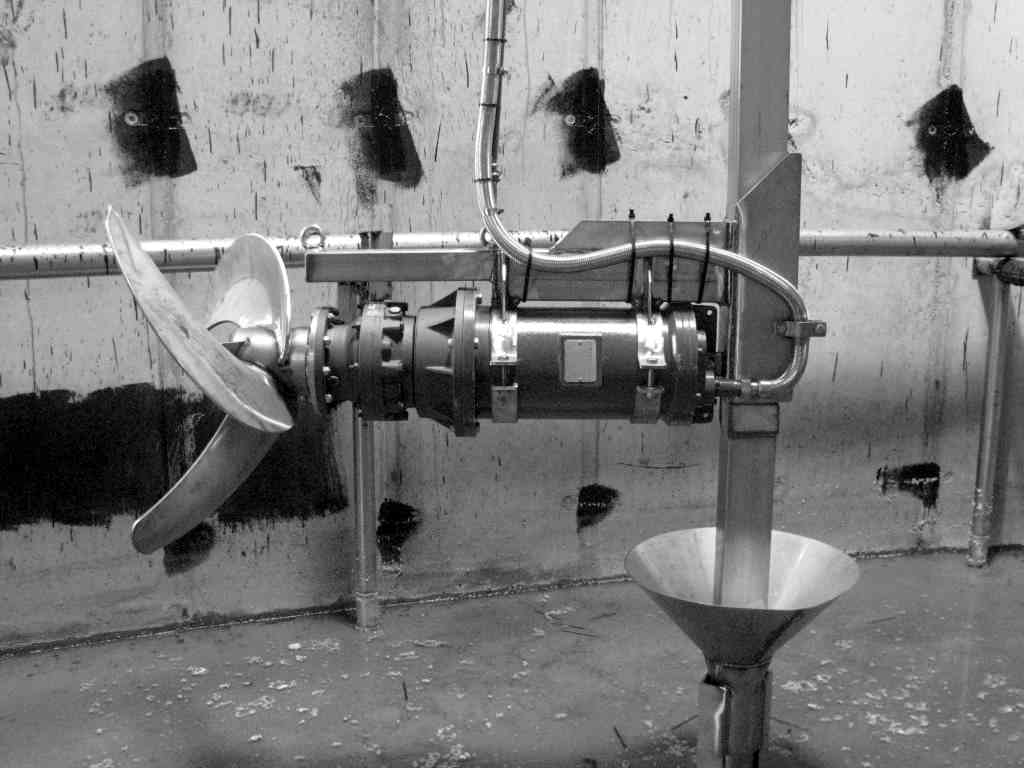
Design and selection questions
Selection factors
-
Properties of liquids : viscosity , density, rheological properties.
-
Versatile applications : suspension, heat transfer, chemical reactions.
-
Space limitations : Tank size and installation location.
Basic arithmetic operations
-
Reynolds number : determines the flow regime.
-
Rated power : Calculate the required power.
-
Pump frequency : Efficiency assessment
Problems and solutions
Frequently Asked Questions
-
High-speed cavitation
-
Corrosion in a chemical environment
-
Asymmetric load imbalance
Technical solutions
-
Use corrosion-resistant materials.
-
Improved blade design
-
Automatic balancing system
Latest innovations
Design optimization using numerical fluid mechanics.
-
Flow modeling for efficiency improvement
-
This can reduce energy consumption by up to 20%.
Composite materials
-
Extension of the service life
-
weight loss
Intelligent systems
-
Automatic speed control
-
Adjust the blade angle if necessary.
In conclusion
High-efficiency axial fans play a key role in many industrial processes. The correct selection and design of these fans can significantly increase process efficiency and enable energy savings. Thanks to recent advances in materials and design methods, the future of this technology looks promising.
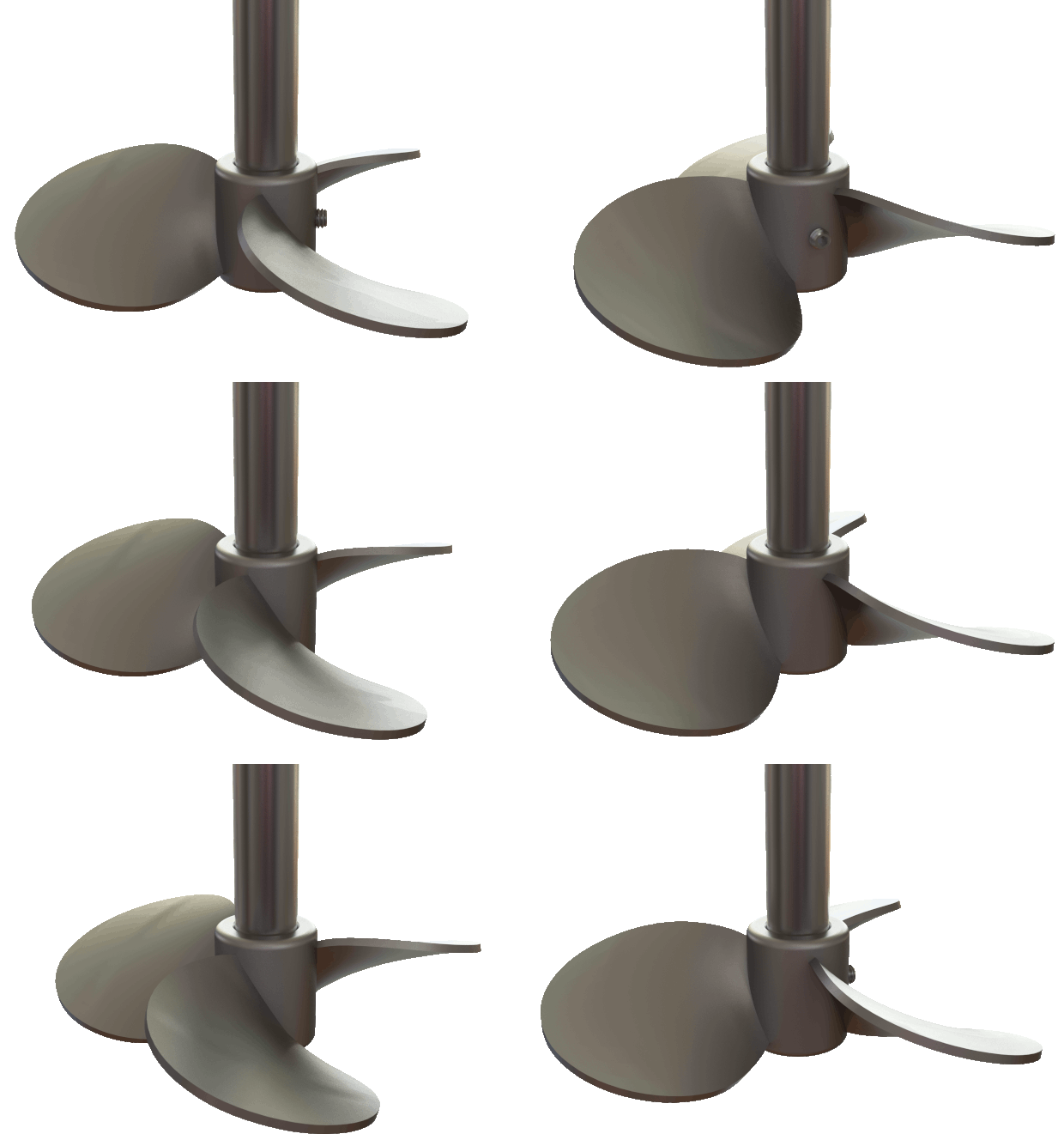
Frequently Asked Questions
1. What is the main difference between axial and radial fans?
Axial fans force the fluid to flow in an axial direction, while radial fans allow the fluid to flow in a direction perpendicular to the axial direction.
2. How can the efficiency of axial fans be improved?
Effective solutions include optimizing the blade angles, using aerodynamic shapes, and reducing the distance between the fan and the tank wall.
3. Can axial fans be used for highly viscous liquids?
Centrifugal fans are typically used for highly viscous liquids, but improved axial fans, such as those with wider blades, can also effectively pump highly viscous liquids.