Natural gas and other industrial gases must be purified and freed from impurities before being fed into pipelines or used in precision instruments. Particles, dust, moisture, or droplets in the gas stream can damage compressors, turbines, valves, and pressure gauges. A dry gas filter is therefore an essential device for preventing these problems .
These filters play a crucial role in gas decompression plants, petrochemical plants, refineries and power plants, where they improve gas quality and ensure system safety by removing solid and liquid particles.
What is a dry gas filter?
A dry gas filter is a mechanical device that is installed in the gas stream and separates suspended solid particles (dust, rust, sand) and small droplets from the gas stream.
These devices typically consist of high-pressure vessels and contain a number of filter elements that retain impurities as the gas flows through them.
The main components of a dry air filter
-
Pressure vessel or housing:
-
They are made of carbon steel or stainless steel.
-
It possesses the necessary strength to withstand the operating pressure of the pipe.
-
-
Filter elements:
-
Main filter compartment.
-
They consist of fibrous materials, cellulose, or microglass fibers.
-
It is capable of absorbing even the smallest particles, up to several micrometers in size.
-
-
Support Panel:
-
These pages contain several pinned items.
-
-
Input/output system:
-
Import of crude oil and export of clean gas.
-
The design aims to ensure a uniform flow distribution.
-
-
Contaminant removal system:
-
This includes special valves or channels for removing accumulated dust and particles.
-
-
Precision instruments:
-
Pressure gauges, differential pressure gauges and safety valves are used to monitor operating conditions.
-
Performance of dry air filters
These filters work according to a simple but very effective principle:
-
The contaminated gas enters the filter chamber.
-
Gas flows through the filter element.
-
Solid and liquid particles are retained on the surface or inside the filter fibers.
-
The purified, dry gas is discharged via the outlet.
This process removes impurities before they enter the precision instruments, and only clean, particle-free gas is used.
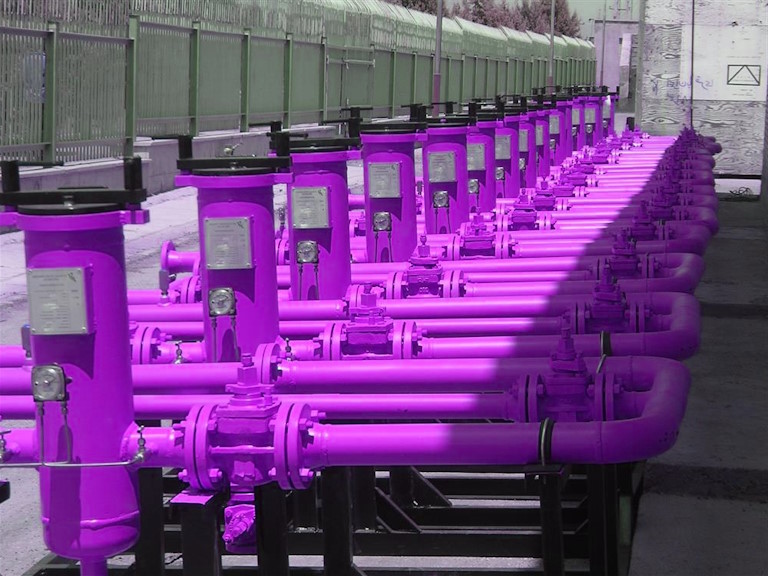
Use of a dry air filter
-
urban and industrial gas pressure reducing stations
-
Petrochemical and oil refineries
-
Gas and combined heat and power plants
-
Gas compressor
-
Gas measuring and control devices
-
Pipelines for the transport and distribution of natural gas
Advantages of using a dry air filter
-
Extending the service life of equipment (turbines, compressors, valves).
-
Reduction of consumption and maintenance costs
-
Prevention of corrosion and damage caused by solid particles
-
Improvement of the quality of the gas flowing into the process stream
-
Reduction of emergency downtime in production facilities
-
Improving the safety of natural gas pipelines
Types of dry air filters
1. By element type
-
Cartridge filter: the most common type; the filter element is replaceable.
-
Bag filter: suitable for large particles.
-
Micron filters: are used to separate very small particles (smaller than 1 micron).
2. By installation method
-
Horizontal design: suitable for high flow rates.
-
Vertical: Suitable for lines with limited space and short length.
3. By nomination level
-
Pre-filter: removes large particles.
-
Fine filter: removes small and suspended particles .
The difference between dry gas filters and separator filters
-
Dry gas filters: Their main function is to remove solid particles and the smallest droplets.
-
Separation filters: They are mainly used to separate large quantities of liquid and large particles.
Many petrol stations install both types of filters simultaneously to ensure optimal filtration.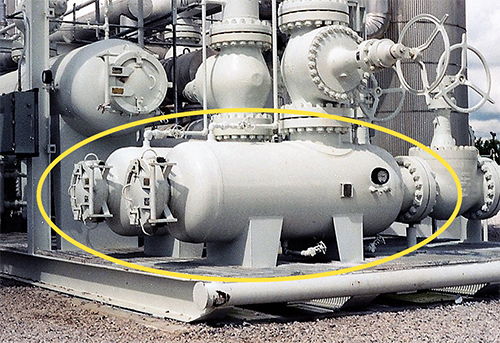
Design standards and requirements
Dry air filters must be designed and manufactured in accordance with recognized international standards :
-
ASME Volume 8, Part 1: Design and Construction of Pressure Vessels.
-
API 12J: Standard for gas separators and filters.
-
ISO 8573: Quality standards for compressed air and gases.
-
ANSI and NACE: These standards define requirements for corrosion resistance and construction materials.
Compliance with these standards ensures safe and efficient filter operation under high pressure and harsh operating conditions.
Factors that influence the selection of dry air filters
-
Gas pressure and flow
-
Operating temperature of the system
-
Types and concentrations of particles in the gas
-
Required filtration accuracy (micrometers)
-
Available installation space (horizontal or vertical)
-
Costs for maintenance and component replacement
Maintenance and repair
Regular maintenance is essential to maintain the efficiency of dry gas filters:
-
Check the components regularly and replace them if they become clogged.
-
Check the pressure difference between the two ends of the filter (this indicates the degree of blockage).
-
Cleaning the cavity of deposits and dust.
-
Calibration and connection of filters for precision instruments.
-
Check the vehicle structure and welds for leaks.
Problems and limitations
-
Microfilters have relatively high purchase costs.
-
The components should be replaced regularly.
-
If the filter is clogged, the pressure in the system drops.
-
Sensitivity to the quality of installation and maintenance
In conclusion
Dry gas filters are essential components in natural gas pipelines, suitable for both transport and consumption. They ensure system quality and safety by removing solid and liquid particles. Using these filters not only extends the service life of sensitive equipment but also reduces maintenance costs and the frequency of emergency shutdowns.
Given the strategic importance of gases in various industries, the correct selection and use of high-quality standard dry gas filters represents a worthwhile investment in the future of any industry.