Due to the increasing demand for safe and reliable water storage systems in construction, agriculture, industry, and municipalities, prefabricated, galvanized water tanks have become widespread in recent years. Their modular design, high strength, corrosion resistance, and quick installation make these tanks an ideal alternative to conventional concrete or polyethylene tanks.
In this article, we will conduct a comprehensive analysis of the characteristics, types, applications, advantages , and key points for the selection and maintenance of prefabricated galvanized water tanks .
What is a prefabricated galvanized tank?
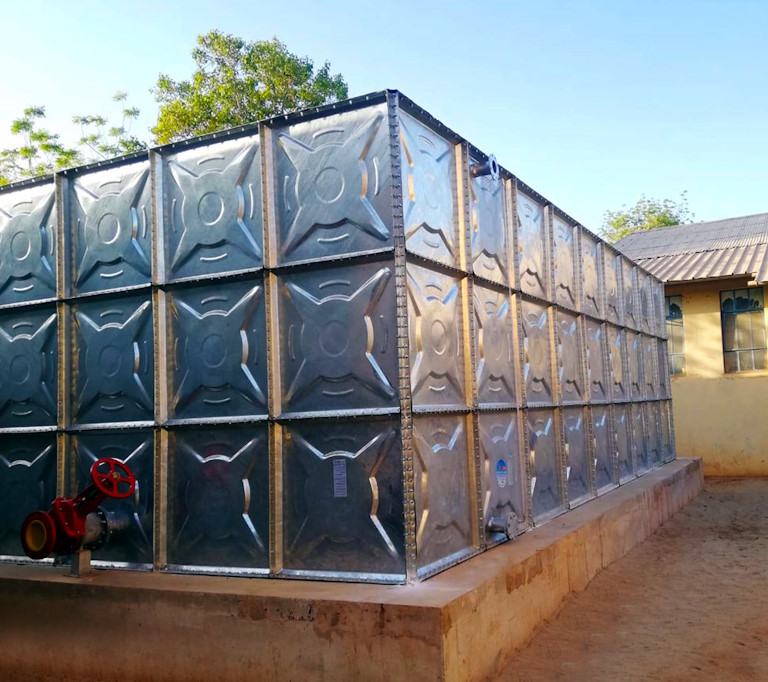
Standard galvanized tanks are storage tanks made of galvanized steel sheets. The sheets are hot-dip galvanized at the factory and then assembled on-site using bolted connections.
Thanks to their modular design, these tanks can be manufactured in various sizes and capacities and can be easily disassembled and reassembled for relocation or expansion .
Construction and main elements of galvanized tanks
-
Hot-dip galvanized steel sheets:
These sheets typically consist of steel and are coated with a zinc layer of 275 to 600 grams per square meter. The zinc layer protects the metal from oxidation and corrosion caused by moisture and oxygen. -
Supporting structure:
consists of galvanized or painted steel profiles that serve to reinforce and stabilize the water tank so that it can withstand the water pressure. -
Sealing rings:
These are installed between metal sheets to prevent water leaks. They are typically made of EPDM rubber or hygienic silicone. -
Accessories and screws:
The connecting parts are made of stainless steel or galvanized material, which ensures their durability. -
Floors and foundations:
Foundations are structures made of reinforced concrete or steel that transfer the weight of the water to the ground. -
Lining (if required):
In some applications (e.g. drinking water or mild chemicals), an epoxy coating or PVC lining may be used to improve hygiene.
Types of prefabricated galvanized tanks
-
Underground, galvanized storage tanks:
the most common type, installed above ground or on a concrete foundation. Suitable for agricultural, industrial, and municipal applications. -
Galvanized gas cylinders:
These are installed in elevated locations to generate natural water pressure in areas without pumps. They are typically mounted on metal or concrete foundations. -
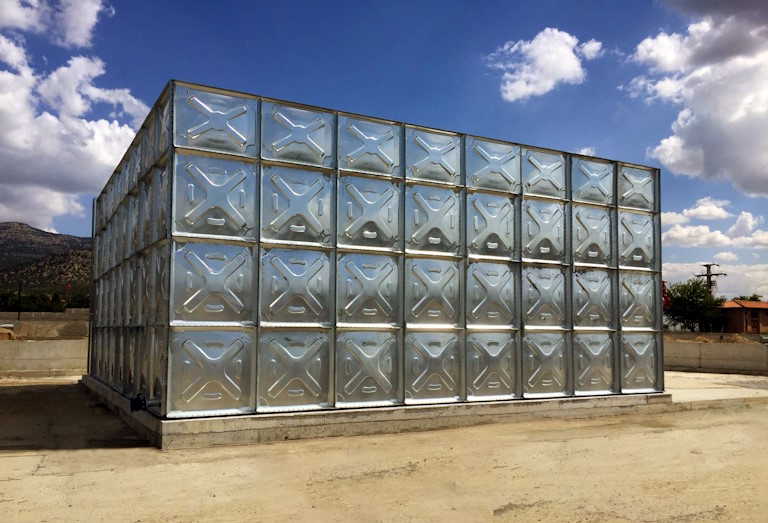
Standard galvanized cubic tanks (sheet metal tanks):
These are made from standardized cubic sheet metal (usually 1 x 1 meter) and can be manufactured to desired dimensions. -
Galvanized water tank with corrosion-resistant inner lining:
Suitable for storing drinking water or chemically sensitive substances. The inside of the tank is insulated with polyethylene or a hygienic epoxy resin coating. -
Galvanized cylindrical tanks:
Made from galvanized metal sheets bent into a circle, they are commonly used for large tanks (more than 50 cubic meters).
Application of prefabricated galvanized tanks
These storage tanks are widely used in various industries and projects due to their high strength, ease of installation, and affordability.
-
Municipal and domestic drinking water storage
-
fire extinguishing tank
-
Storage of irrigation water for farms and greenhouses
-
Rainwater collection
-
Storage of cooling water in power plants and factories
-
Storage of soft, non-aggressive industrial fluids
-
Suitable for temporary projects or areas with limited infrastructure.
Advantages of prefabricated, galvanized water tanks compared to other types of water tanks.
-
Assembly is quick and easy:
all parts are prefabricated and delivered directly from the factory, allowing for rapid on-site assembly. Assembly typically takes one to three days. -
Easy transport:
Thanks to the modular design, the water tank can be opened and installed in a new location. -
Durability and long service life:
The zinc coating is resistant to corrosion and environmental influences, extending the service life of the tank to more than 20 years. -
Low maintenance costs:
Unlike concrete tanks, which need to be resealed regularly, galvanized tanks require less maintenance. -
UV and weather resistant:
These water tanks are extremely resistant to sunlight, rain, moisture and extreme cold. -
Future-proof capacity expansion:
You can easily increase the storage capacity by adding more panels. -
Elegant industrial style:
The glossy, polished, galvanized surface gives the device a modern and clean look.
Key points for selecting and installing galvanized water tanks
-
Checking the paper thickness: For mass production, thicker paper (2 mm to 4 mm)
should be used to better withstand hydrostatic pressure. -
Note the type of galvanizing:
Hot-dip galvanized coatings are more durable than cold-galvanized coatings and are recommended for long-term projects. -
Foundation preparation:
The subsoil must be absolutely level, stable and free from shrinkage to avoid deformations and leaks. -
Insulation in cold regions:
To prevent water from freezing, polymer insulating materials or mineral wool can be used. -
Install inspection and venting valves:
for cleaning and to prevent the formation of negative pressure in the tank. -
Installing a water level or buoyancy sensor helps
to monitor the water level and prevent flooding . -
Check the manufacturing standards:
Ensure that the storage tank was manufactured according to ISO, DIN or BS standards.
Regular maintenance and repair of galvanized tanks
Although these storage tanks are extremely durable, the following measures should be taken to extend their service life:
-
Annual inspection of screws and seals
-
Interior cleaning and disinfection should be carried out every 6 to 12 months.
-
Check the galvanizing and repair any damaged parts.
-
Draining sediment from the bottom of the water tank.
-
When using drinking water, it is necessary to carry out regular microbiological analyses.
If these steps are followed, the water tank can be used without problems for over 20 years.
Price for prefabricated galvanized tanks
The price of these fuel tanks depends on several factors, including:
-
Dimensions and sizes of the storage tank
-
thickness of the steel sheet
-
Type of galvanizing (cold galvanizing or hot-dip galvanizing)
-
Types and basic rules
-
Interior lining (if water purity is required)
-
On-site costs, transport and installation
The price for a finished galvanized water tank ranged between 2 and 4 million Toman per cubic meter (1404).
In conclusion
Prefabricated, galvanized water tanks are among the most efficient and cost-effective options for water storage in industrial, agricultural, and urban projects . Their key advantages include high strength, rapid installation, and ease of transport and maintenance. If you are looking for a reliable, durable, and versatile solution for storing water or other liquids, prefabricated, galvanized water tanks may be the ideal choice.